Pavement Design I
From wheel load to layer thickness. Build the figure, draw the gear, follow the stress path down to the subgrade — then work each homework with the tool that was written for it, as the semester reaches it.
- Online tools
- 2 live of 20
- Homeworks
- 0 released of 10
- Textbook chapters
- 13 + 7
- Instructor
- Imad L. Al-Qadi
Start in the browser
Purpose-built instruments for this course — nothing to install, nothing to license, and every number they produce is one you could have computed by hand. 2 are open now; the rest unlock alongside the homework that needs them.
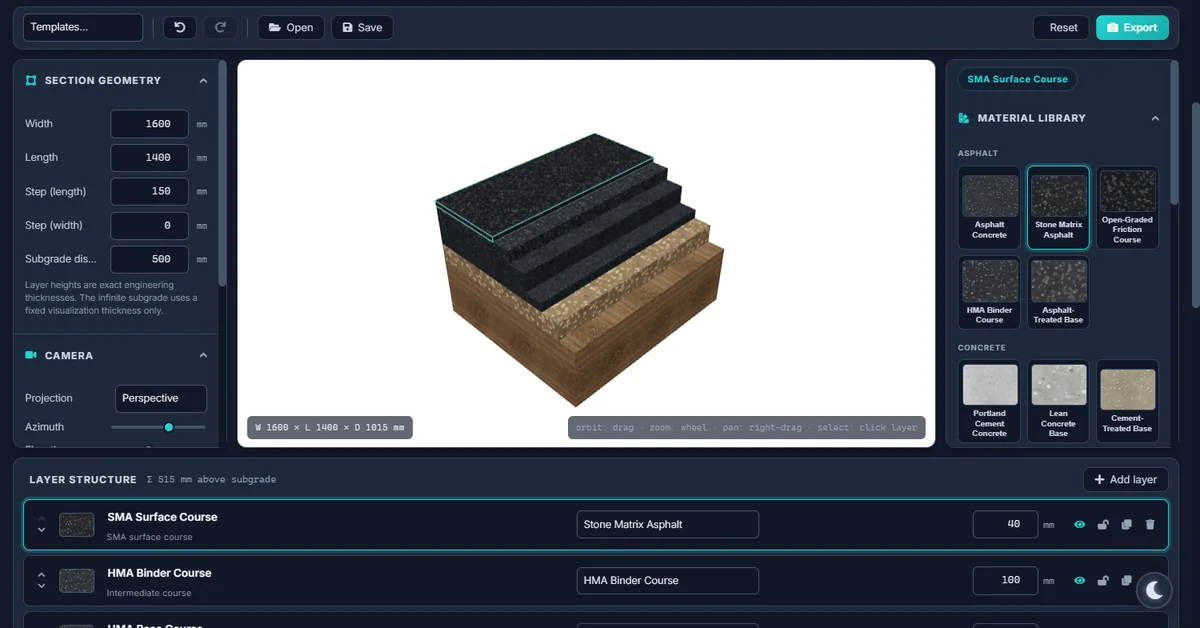
Cross-Section Studio
The figure every write-up needs and nobody wants to redraw: a true-to-scale 3-D pavement section, eighteen procedural materials, thirteen airfield and highway templates — and the PNG copied straight to your clipboard, with or without a background.
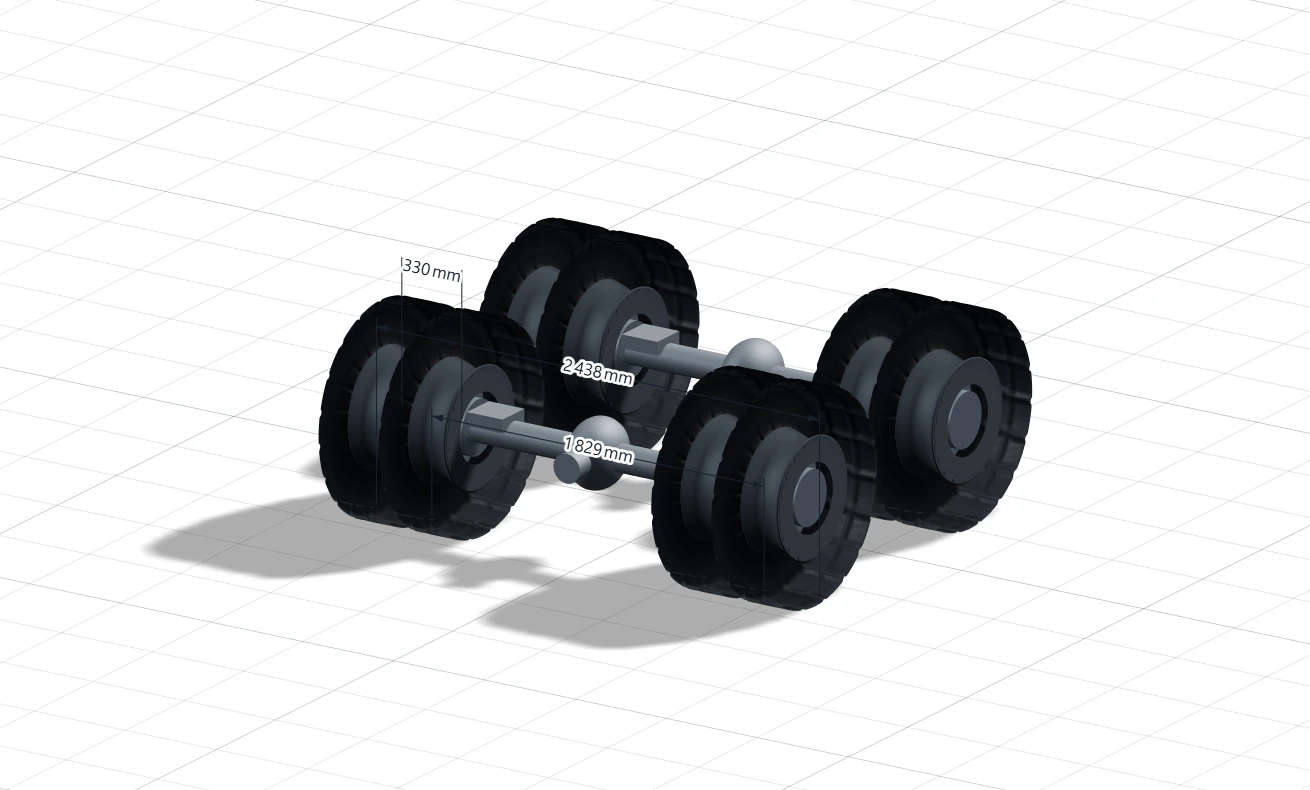
Gear3D
Truck axle configurations and aircraft landing gear drawn true to scale in 3-D, with spacings and track widths as measurable dimensions — and contact-patch corner coordinates exported in millimetres for a finite-element pre-processor.
Ten assignments, one structure
The course is organized around its homeworks. Each one pairs the assignment with the textbook chapters behind it and the tools you need to solve it — from surface distresses down to the subgrade, and back up through design.
- HW1
Pavement Types, Layers & Distresses
What the layers of flexible and rigid pavements do, how mechanistic-empirical design works, and how pavements fail — pumping, rutting, and the damage done by different axles and tire pressures.
Fundamentals Coming soon - HW2
Subgrade & Material Characterization
Fit the generalized resilient modulus model to triaxial data, evaluate subgrade strength with the CBR test, and review lime stabilization of weak soils.
Materials Coming soon - HW3
Stresses in Layered Systems
Stresses, strains, and deflections in one-, two-, and three-layer systems under a circular load, using the classic Boussinesq and Burmister charts and tables.
Analysis Coming soon - HW4
Multilayer Elastic Analysis
Analyze a four-layer structure under a 720 kPa, 145 mm circular load with a layered-elastic program (e.g., WinJULEA), plot the response profiles with depth, and interpret each layer.
Analysis Coming soon - HW5
Traffic Loading & Volume
Design traffic in ESALs: load equivalency factors, truck factors, growth, and lane distribution — converting mixed traffic into the single number that drives thickness design.
Loads & Drainage Coming soon - HW6
Drainage Design
Estimate inflow, size the permeable base, and check filter criteria — with FHWA’s DRIP software as a check on hand calculations.
Loads & Drainage Coming soon - HW7
AASHTO Flexible Pavement Design
The AASHTO 1993 flexible design procedure end to end: structural number, layer and drainage coefficients, reliability, and the design nomographs.
Design Coming soon - HW8
Mechanistic-Empirical Flexible Design
An IDOT-style mechanistic design for a rural four-lane highway, then a WinJULEA sublayered analysis feeding AASHTOWare transfer functions to predict fatigue cracking and rutting versus load repetitions.
Design Coming soon - HW9
Rigid Pavement Design
Concrete pavements: curling stresses, Westergaard edge and corner loading, joint design, and the rigid design procedures of Chapter 12.
Design Coming soon - HW10
Airfield Pavements & Life-Cycle Assessment
Check runway ACR/PCR compatibility for a B747-400 and design an airfield section with FAARFIELD; then run a full pavement life-cycle assessment to find the stage that dominates GHG emissions.
Design Coming soon
Huang — Pavement Analysis and Design
The reading map for the course — 13 chapters and 7 appendices, each summarised and linked to the homework it backs. The book is a copyrighted commercial text and is not hosted here; the University Library is where you borrow it.